Train the AI on your business
Build the knowledge base the AI answers from — the single biggest lever on answer quality.
On this page
Watch: Prepare your AI knowledge
18 seconds · Captioned workflow illustration, not a screen recording. No audio.
View the annotated workflow diagram
Read the video transcript
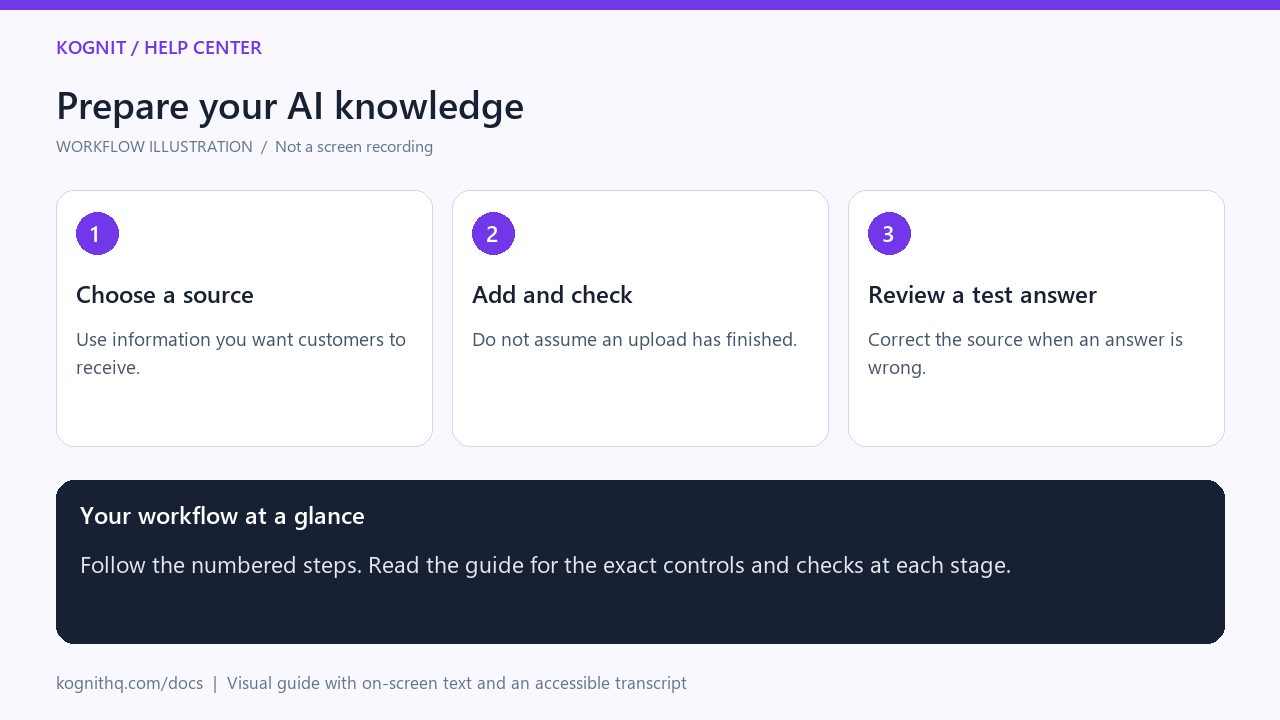
- Choose a source. Open AI Brain. Start with current policies, FAQs, or a supported knowledge source.
- Add and check. Add your source and check its processing result. Fix missing or outdated information.
- Review a test answer. Ask a question covered by the source. Check the answer against your policy before enabling automation.
The AI only knows what you tell it
Kognit's AI answers from your knowledge base and your connected data. It does not answer from general internet knowledge about your industry, and it will not invent a returns policy you never wrote down.
That is a deliberate constraint. It means an empty knowledge base produces an AI that escalates everything — frustrating, but never wrong in a way that costs you a customer.
Adding knowledge
Open AI Brain and add articles. Each has a title, a body, and an enabled switch. Only enabled articles are used, so you can draft without exposing anything.
Articles are retrieved by relevance to each customer question, so more articles is genuinely better as long as each is accurate.
What to add first
Start with the five questions you personally answer most often. Then:
- Shipping — carriers, timeframes per region, what happens when something is late
- Returns and exchanges — window, condition, who pays postage, how a refund is issued
- Order changes — how long a customer has to change an address or cancel
- Product care — sizing, materials, compatibility, warranty
- Company facts — hours, locations, contact routes
How to write an article the AI can use
Answer the question in the first sentence. Retrieval favours articles that state the answer plainly.
Weak: Our returns process has been designed with customer satisfaction in mind and reflects our commitment to quality.
Strong: You can return any unworn item within 30 days of delivery for a full refund. We pay return postage in the UK; international customers pay their own.
Be specific and absolute. "Usually a few days" gives the AI nothing to say. "2–3 working days in the UK, 5–7 in the EU" does.
Write the exceptions down. The cases that trip up new hires are exactly the ones that trip up the AI.
One topic per article. A single article covering shipping, returns, and sizing retrieves poorly for all three.
Catalog and orders come free
If you connected Shopify or WooCommerce, your products and orders are already available — you do not need to write articles about them. The AI can look up a specific order's status and answer from live data.
See Connect Shopify.
Keeping it current
The most common cause of a wrong AI answer is a policy that changed while the article did not. When you change a policy, update the article in the same hour. Anything else and the AI will keep confidently telling customers the old rule.
Review escalations weekly: every question the AI escalated for low confidence is a candidate for a new article.
Related